|
The water-binding and rapid hydration of guar in cold water to form a viscous colloidal sol is its most important characteristic. These properties are utilized in ice-cream stabilizers, especially in high temperature, short time processes where condition call for 80oC, for 20-30 seconds. Guar binds the free water without disturbing the viscosity characteristics of the mix. Guar imparts body, texture, chewiness and heat-shock resistance to ice-cream. Guar imparts body, texture, chewiness and heat-shock resistance to ice-cream.
|
|
 |
|
|
|
In combination with calcium sulfate and an emulsifier, it gives a dry and stiff ice-cream with retarded melt-down. Guar is also used with sodium hexametaphosphate and sodium citrate as a stabilizer of ice cream mixes. It is included in the ice cream standards in the Food Chemicals codex.
|
|
 |
|
|
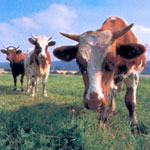
Guar is also used in the stabilization of popsicles and sherbets for similar reasons applying to ice cream. In addition, it retards color migration and is very stable in this acidic media.Guar is used in soft cheese to improve the yield of curd solids. It gives curds of soft, compact and excellent texture, with a separated whey that is very limpid.
Cheese spreads are made by mixing 1-2% guar, melting and then cooling the homogenous mixture.
|
|
|
|
Bakery |
|
|
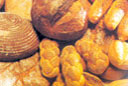
Guar when added to dough while kneading, increases the yield, gives greater resiliency, and a drier, less flabby appearance. The baked products have a better and softer texture and retain freshness longer. In cake and biscuit dough, guar gives a softer and more moist product that is easily removed from the molds and easily sliced without crumbling. Guar at 1%- added to doughnut, batter, imparts binding and film-forming properties that retard ,grease and fat penetration into the yeast fermented dough.
|
|
 |
| Guar is used to prevent frozenpie filling from dehydrating, shrinking, and cracking. It is used in icings for its water-binding properties. |
|
|
| Meat |
|
|
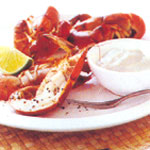
Guar binds all the free moisture and retards shrinkage when used at 0.2-0.5% based on meat weight in sausage and pet foods. In addition it acts as lubricant in the sausage stuffing operation, and decreased loss of weight during storage.
|
|
 |
|
|
| Beverage |
|
|
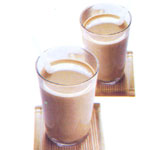
Fruit nectars, consisting of pure fruit puree, artificial fruit juices, sugar, ascorbic acid, citric acid and about 0.2-0.8% guar have good mouth feel and stable viscosity. Guar plus carrageenan is used to stabilize chocolate syrups and powdered chocolate mixes.
|
|
 |
|
|
|
Salad Dressing |
|
|
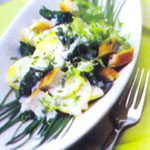
Guar stabilizes salad dressing by increasing the viscosity of emulsion and decreasing the separation rate. It is compatible with highly acidic emulsions and effective at 0.2-0.8% of total weight. It has replaced tragacanth in many pickles and relish sauces where rapid cooling is used.
|
|
 |
|
|
| Paper Industry |
|
|
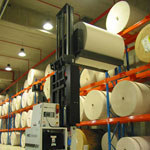
Over ten million kilograms of gums ( guar, locust bean, and tamarind seed gums) are used annually by the paper industry as wet and additives. The gum is added to the pulp suspension at the suction side of the pulp suspension at the suction side of the fan pump just before the sheet is formed on either a fourdriner or cylinder machine. Along with the lignin removed in the pulping process, much of the natural hemicelluloses (mannas and xylems) are removed.
|
|
 |
|
Guar replaces and supplements these hemicelluloses in paper bonding with many advantages; 1. improved sheet formation with a more random distribution of pulp fibers ( less fiber bundies.) 2. Increased mullen or burst strength. 3. increased fold strength. 4. Increased tensile strength. 5. Increased pick. 6. Increased flat crush of corrugating medium. 7. Increased machine speed. 8. increased retention of fines. 9. Improved Finish. 10. Decreased porosity.
The hydrogen-bonding effect is one of the major factors affecting fiber to fiber bonding. The rigid molecular structure of guar with its primary and its cis-secondary hydroxyl groups contributes to its interaction with the cellulose fibers in counteracting the fiber's natural tendency to lie in a machine oriented pattern.
|
|
|
| Pharmaceutical and Cosmetics |
|
|
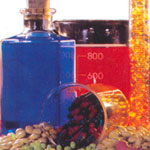
Guar has been used as an appetite depressant, its thickening ability is utilized in various lotion and cream. Coarse guar gum is often used as a binding and disintegrating agent in compressed tablets.
|
|
 |
|
|
|
Mining Industry |
|
|
This same hydrogen-bonding action is utilized with the hydrated mineral surface of the clay, talc, or shale. Guar acts in froth flotation and potash as an auxiliary reagent, depressing the gangue material. Guar is used as a setting agent to speed the settling of suspended solids in slimes and tailing from ore beneficiation. The separated water is then recycled. Guar is added to slime or clay pulp causes coagulation and allows faster filtration since the filter screen is no longer blinded by small particles.
|
|
 |
|
|
| Water Treatment |
|
|
Guar has U.S. Public Health Service approval in potable water treatment as a coagulant aid toghter with alum, ferric sulfate, and lime. Guar increased the size of the flocinitially formed by the coagulant, thereby increasing the rate of settling of solid impurities, reducing solids carry over to the filters, and increasing periods between back-washes. In industrial waters, guar flocculates clays, carbonates, hydroxides and silica when used alone or in conjunction with inorganic coagulants.
|
|
 |
|
|
|
Tobacco Industry |
|
|
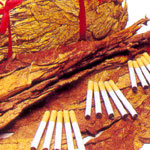
Guar is used as binder for fragmented tobacco fines to produce reconstitute Tobacco sheets. These flexible sheet with tensile strength and thickness of leaf tobacco, are blended with leaf tobacco, and retain the taste, flavor and aroma of an all-leaf product. Sheets are formed by passing a moist mixture of guar humectant, and tobacco fines between closely spaced steel rollers revolving at different peripherals speeds.
|
|
 |
|
|
|
Petroleum Drilling |
|
|
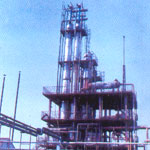
Guar has been used to control water flow and as a protective colloid in oil well drilling muds. It is also used in acid fracturing to increase oil flow.
|
|
 |
|
|
| Textile Industry |
|
|
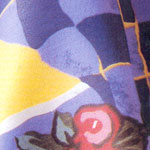
Guar Gum derivatives are used as print-paste thickeners. These derivatives are also used in roller and screen printing, as well as finishing agent. They are more economical than locust bean gum derivatives.
|
|
 |
|
|